
Choosing a jaw crusher for a quarry starts with the feed conditions and the objectives of the complete line, followed by a comparison of model specifications. Feed size, material hardness and target throughput are connected. If any of them lacks a sound basis, the equipment may be poorly matched when production starts. A complete selection brief is more useful than looking only for a larger feed opening or a higher motor rating.
Check feed size and actual composition
Maximum feed size determines whether the machine can receive the material, but measuring one apparently representative rock is not enough. Understand the normal proportion of large lumps, particle-size distribution, moisture and clay content. Hardness and abrasiveness are different properties; both influence crushing and wear. Where the feed varies significantly, review prescreening, feed control and any necessary crushing trials.
Define the target in terms of effective output
Set the target throughput against effective working hours and the requirements of downstream equipment. If several aggregate grades are required, include screening, return loads and the capacity consumed by off-specification material. A published equipment capacity range applies under particular conditions; it is not a promise for every site. Record both raw-material throughput and usable finished-product output so the two measures are not confused.
Match the discharge setting to downstream equipment
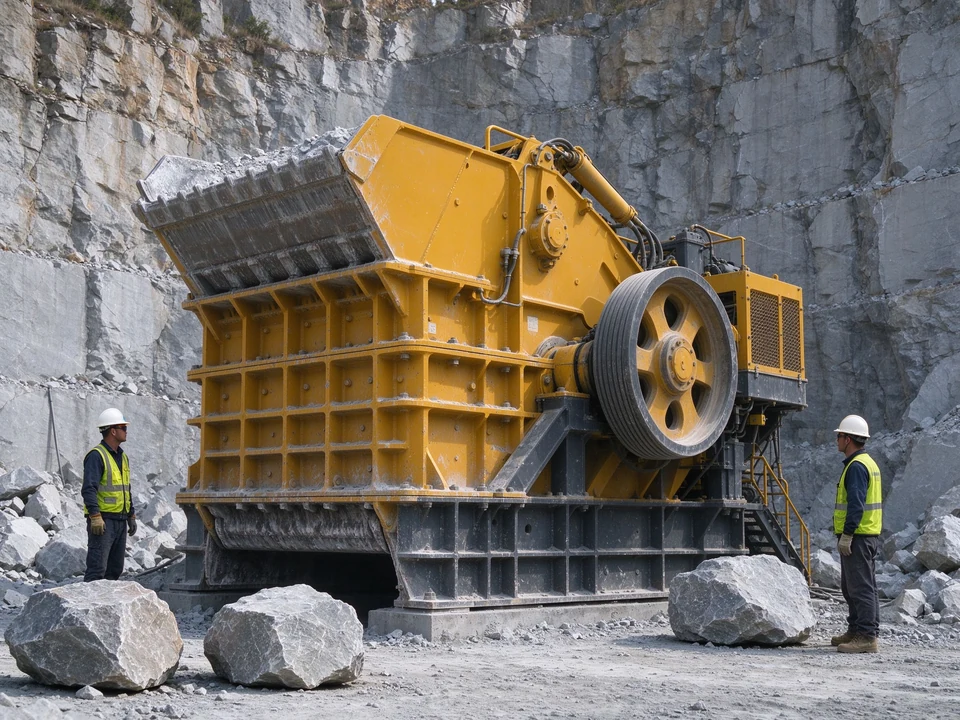
For the RP-JC-1200, the supplied documentation lists a maximum feed size of 750 mm, a discharge setting of 100–200 mm and a capacity of 150–350 t/h. When selecting a setting, check the feed limit of the secondary crusher and the conveying capacity. The discharge setting is not the size of every particle in the output. Final grading still depends on subsequent crushing and screening.
Compare installation and maintenance requirements
In addition to the main machine specifications, check foundation loading, transport dimensions, lifting conditions, power supply and maintenance space. Machine weight or restricted site access can affect installation planning. Jaw plates, fasteners, lubrication points and transmission components need routine checks. Include spare-parts availability and the capability of the maintenance team in the purchasing discussion, rather than comparing only the initial price and overlooking ongoing operating inputs.
Review feeding stability and the supporting circuit
Feeding directly affects the load on a jaw crusher. Persistent uneven feed, short bursts of concentrated loading or long interruptions can move actual performance away from the expected conditions. Describe the loading equipment, delivery rhythm and hopper arrangement when discussing a configuration. Review the feeder and prescreening arrangement where needed. Evaluating these inputs together with the crusher specifications gives a clearer indication of whether the equipment matches the way the site operates.
Use a complete brief to obtain configuration advice
Before requesting a quotation, prepare the material name, maximum lump size, hardness and abrasiveness, target throughput, downstream equipment and project location. Explain whether the work is a modification to an existing line. If operating conditions are unclear, discuss sampling and trials before confirming the equipment setting and capacity target. These inputs help RockPeak compare the model, supporting scope and delivery conditions, reducing repeated revisions to the proposal.